Bangladesh is often introduced through its rivers, tea gardens, mangrove forests, and centuries-old heritage sites. Yet for travelers seeking a deeper understanding of the country, history is equally important. Alongside landmarks connected to the Liberation War of 1971 and the Language Movement of 1952, a new chapter has emerged in the story of modern Bangladesh—the July Uprising Bangladesh.
For many Bangladeshis, the events of 2024 represented a significant moment in the country’s contemporary history. While interpretations and political perspectives continue to evolve, the locations associated with the July Uprising have become important places for understanding modern civic movements, student activism, and the changing social landscape of Bangladesh.
For international travelers, exploring these sites is not about politics. It is about understanding how history unfolds, how cities evolve, and how public spaces can become part of a nation’s collective memory.
What Was the July Uprising Bangladesh?
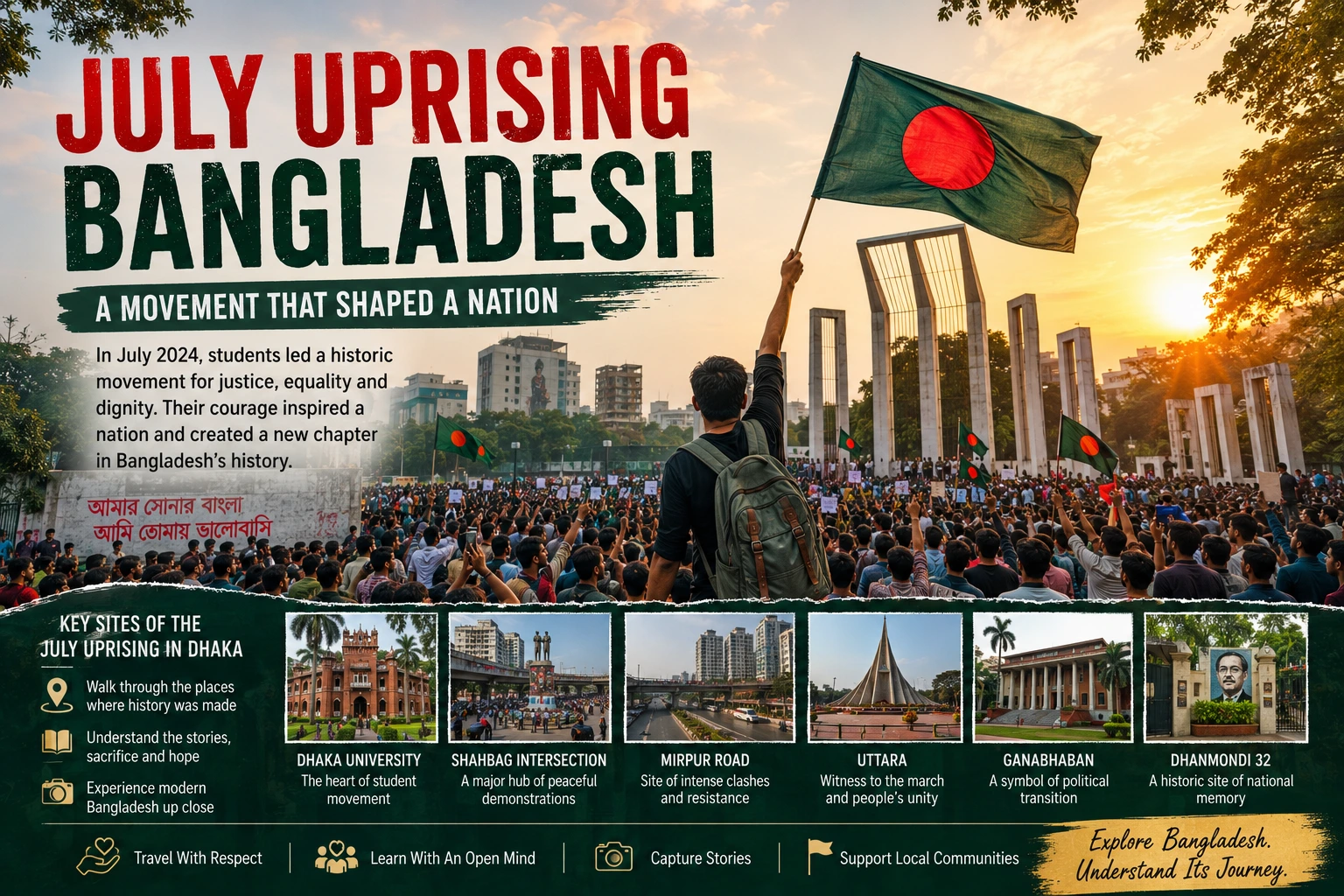
The July Uprising Bangladesh refers to the large-scale student-led demonstrations and public protests that began in July 2024.
The movement initially focused on concerns surrounding public-sector employment policies and broader social issues. As events unfolded, the demonstrations expanded and attracted participation from students, professionals, and citizens from different backgrounds.
The movement became one of the most discussed events in recent Bangladeshi history and drew international attention to the country’s evolving political and social landscape.
Today, many of the locations associated with these events remain active public spaces that visitors can explore while learning about contemporary Bangladesh.
Why the July Uprising Matters to Travelers
Many visitors come to Bangladesh expecting to discover ancient mosques, Mughal architecture, tea estates, and the Sundarbans.
What often surprises them is how dynamic and fast-changing the country is.
Understanding the July Uprising helps travelers appreciate modern Bangladesh beyond traditional tourism. It provides insight into:
- The role of students in Bangladeshi society
- Civic participation and public discourse
- Contemporary urban culture
- The importance of Dhaka as a center of national events
- The relationship between history and public spaces
Just as visitors explore sites connected to the Liberation War or the Language Movement, many are now interested in understanding locations associated with more recent historical developments.
Dhaka: The Heart of Modern Bangladesh
Most locations connected to the July Uprising are found in Dhaka, the capital of Bangladesh.
Home to more than twenty million people, Dhaka is a city where history and modern life coexist side by side.
Ancient mosques stand beside modern universities. Colonial architecture shares space with contemporary commercial districts. Traditional neighborhoods exist only minutes away from rapidly developing urban centers.
Travelers exploring Dhaka quickly realize that understanding the city means understanding both its past and present.
Those interested in gaining a broader perspective often begin with a Discover Dhaka City experience, which introduces visitors to major landmarks, cultural districts, and the evolving character of the capital.
Dhaka University: Where Ideas Shape History
Dhaka University has long played an important role in Bangladesh’s history.
The university was closely associated with the Language Movement of 1952, the Liberation War of 1971, and numerous social and cultural movements throughout the country’s history.
During the July Uprising, areas surrounding the university once again became gathering points for students and activists.
Today, visitors can walk through the campus, visit its historic buildings, and observe the vibrant academic environment that continues to influence national conversations.
For travelers interested in culture and history, Dhaka University offers valuable insight into the intellectual life of Bangladesh.
Shahbag: A Symbolic Public Space
Among the most recognizable locations associated with modern civic movements is Shahbag.
Situated near museums, universities, and cultural institutions, Shahbag has long served as a gathering point for public events and demonstrations.
Its central location makes it an important landmark for understanding the social and political life of Dhaka.
Travelers exploring nearby attractions often combine a visit to Shahbag with the Bangladesh National Museum and other cultural sites located in the area.
Understanding Public Spaces Through History
One of the most fascinating aspects of Bangladesh is how ordinary public spaces often carry extraordinary historical significance.
A road intersection may have witnessed major demonstrations.
A university square may have hosted important speeches.
A public park may have played a role in national events.
This layering of history creates opportunities for travelers to engage with Bangladesh on a deeper level.
The July Uprising added another chapter to this evolving urban landscape.
Ganabhaban and Contemporary Historical Memory
Ganabhaban has historically served as an important government residence and administrative location.
Because of its association with major events in recent Bangladeshi history, it has become a place of public interest for those seeking to understand contemporary developments.
While access and visitor experiences may vary over time, its symbolic role within the national narrative continues to attract attention.
For travelers, understanding such sites helps connect recent events with the broader story of Bangladesh.
Dhanmondi and the Evolution of National Identity
Dhanmondi is one of Dhaka’s most historically significant neighborhoods.
It contains locations associated with multiple periods of Bangladesh’s development, from the Liberation War era to contemporary events.
Walking through Dhanmondi allows visitors to observe how historical memory, urban development, and everyday life intersect within the capital.
The area is also popular among photographers, offering a blend of modern architecture, public spaces, and cultural landmarks.
Those interested in documenting urban life often combine these experiences with a Street Photography Tour in Dhaka, which provides unique opportunities to capture the city’s human stories.
Exploring Modern History Alongside Old Dhaka
While the July Uprising represents a recent chapter in Bangladesh’s story, visitors should not overlook the city’s deeper historical roots.
The narrow streets of Old Dhaka reveal centuries of cultural, architectural, and commercial history.
From Mughal-era structures to colonial buildings and bustling traditional markets, the area offers a striking contrast to the modern districts associated with contemporary events.
An Old Dhaka Tour provides valuable historical context and helps visitors understand how the city evolved into the dynamic metropolis it is today.
Connecting the Present With Bangladesh’s Rich Heritage
Many travelers discover that modern history becomes more meaningful when viewed alongside older cultural and historical sites.
Destinations such as Sonargaon and Panam City offer insight into Bengal’s rich heritage, trade networks, and architectural legacy.
Combining modern historical sites with an Old Dhaka and Sonargao Tour allows visitors to experience multiple layers of Bangladesh’s story in a single journey.
From medieval capitals to modern civic movements, the country’s history remains remarkably interconnected.
Beyond Dhaka: Discovering the Diversity of Bangladesh
Although the July Uprising was centered largely in Dhaka, understanding Bangladesh requires exploring the country beyond the capital.
Travelers often continue their journey to destinations such as:
- Sreemangal’s tea gardens
- Sylhet’s rivers and landscapes
- The Sundarbans mangrove forest
- Bagerhat’s UNESCO heritage sites
- North Bengal’s archaeological treasures
Experiences such as the Sreemangal and Sylhet Tour, Sundarbans and Bagerhat Tour, and North Bengal Tour reveal the cultural and geographic diversity that makes Bangladesh one of South Asia’s most fascinating destinations.
Why Travelers Are Increasingly Interested in Modern Bangladesh
Bangladesh remains one of the least-explored destinations in Asia.
While neighboring countries receive millions of tourists each year, Bangladesh continues to offer a more authentic and less commercialized travel experience.
Visitors are increasingly drawn by:
- Rich cultural traditions
- Historic architecture
- River life
- Street photography opportunities
- UNESCO World Heritage Sites
- Contemporary history and social change
Understanding events such as the July Uprising provides additional context that helps travelers appreciate the country beyond its landmarks.
It reveals a nation that continues to evolve while remaining deeply connected to its history and cultural identity.
A New Chapter in Bangladesh’s Story
History is never static.
Every generation contributes new chapters to the story of a nation.
For Bangladesh, the July Uprising represents one of those chapters.
Whether viewed through the lens of history, culture, education, or travel, the sites associated with these events offer visitors an opportunity to engage with contemporary Bangladesh in a thoughtful and meaningful way.
Combined with the country’s remarkable heritage, warm hospitality, and diverse landscapes, they help create a richer understanding of one of South Asia’s most intriguing destinations.
Frequently Asked Questions
What is the July Uprising Bangladesh?
The July Uprising Bangladesh refers to the student-led demonstrations and public protests that began in July 2024 and became an important event in modern Bangladeshi history.
Where did the July Uprising take place?
Many key events occurred in Dhaka, particularly around Dhaka University, Shahbag, Dhanmondi, and other major public spaces.
Can travelers visit sites connected to the July Uprising?
Yes. Many locations associated with the events remain accessible public areas that visitors can explore as part of a broader historical and cultural journey through Dhaka.
Why is the July Uprising important?
The events are considered significant because they became part of Bangladesh’s evolving contemporary history and contributed to national discussions about society, governance, and civic participation.
What other historical places should travelers visit in Bangladesh?
Travelers interested in history often visit Old Dhaka, Sonargaon, Panam City, the Liberation War Museum, Bagerhat, Paharpur, and Mahasthangarh.
Is Dhaka worth visiting for history lovers?
Absolutely. Dhaka offers a unique combination of Mughal heritage, colonial architecture, Liberation War landmarks, and contemporary historical sites.